
Telehealth
What is Telehealth?
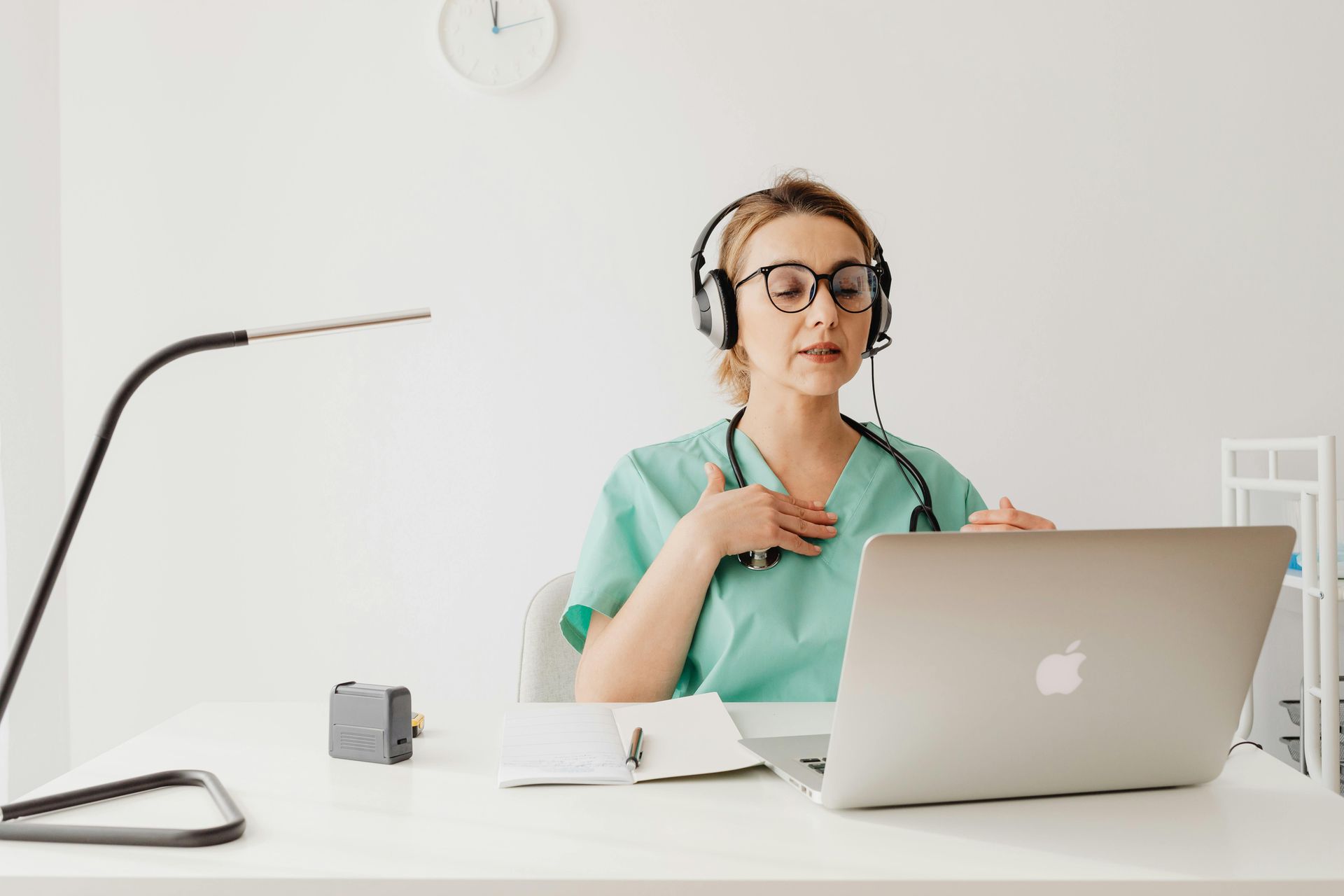
We offer telehealth services to provide patients with convenient access to medical care through secure, real-time video consultations. Telehealth visits allow you to receive care remotely while maintaining continuity with a physician who is familiar with your complete medical history and has full access to your medical records.
Telehealth is appropriate for select, non-emergent conditions and follow-up care, but it may not be suitable for all medical concerns. If you are uncertain whether a virtual visit is appropriate for your needs, please contact the office, and guidance will be provided to ensure you receive the most appropriate care
Before Your Appointment
To help ensure a smooth Telehealth visit, please prepare by following these steps:
- Practice opening your mouth wide in front of the camera, using a flashlight if necessary, so we can get a clear view if needed.
- If you're experiencing coughing or difficulty breathing, try to check your respiratory rate (count the number of breaths per minute) and heart rate (see FAQs for instructions).
- Take clear, close-up photos of any rashes to send us, if requested, for a better visual evaluation.
- Write down all medications being taken, including the last dose of ibuprofen or acetaminophen, so we can advise appropriately.
- Have current medications, including inhalers or spacers, available and ready to show during the visit.
- Prepare any questions you may have in advance so you don’t forget them during the appointment.
Being prepared helps us provide the best possible care during your Telehealth visit!
Different Types of Telehealth Appointments
While Telehealth is a convenient and effective option for many conditions, there are certain limitations to virtual visits. Some acute care concerns cannot be fully evaluated via video conferencing. For example, we cannot:
- Listen to your lungs or evaluate ear pain
- Assess significant coughs or respiratory concerns
- Perform physical exams that require hands-on evaluation (e.g., sore throat, abdominal pain)
- Conduct tests like urinary tract infections (UTIs), strep, or flu testing
After a video consultation, if we determine that an in-person examination is necessary, we may ask you to come into the office for a follow-up sick visit to provide a more thorough physical exam.
Telehealth appointments can be scheduled through our front desk or patient portal. If you’re unsure whether your concern can be addressed virtually, please call us, and we'll help guide you to the best option.
Telehealth FAQs
Find answers to commonly asked questions on telehealth.
How do I take a temperature?
How Do I Take a Temperature?
When Is There a Fever?
A fever is present when the temperature is:
Rectal, Forehead, or Ear: 100.4°F (38.0°C) or higher
Oral (mouth): 100.0°F (37.8°C) or higher
Armpit: 99.0°F (37.2°C) or higher
Note: Ear temperatures are not accurate for infants under 6 months.
Best Place to Take the Temperature
Most accurate: Rectal
Very accurate: Forehead
Accurate if used correctly: Oral and Ear
Least accurate (screening only): Armpit
Temperature by Age
Infants under 3 months:
Use armpit for screening. If ≥99°F, recheck rectal or forehead and contact your provider right away.
3 months–4 years:
Rectal or forehead preferred. Ear thermometer may be used after 6 months.
4 years and older (children, teens & adults):
Oral, ear, or forehead temperatures are appropriate.
How to Take the Temperature
Rectal (infants & young children):
Use lubricant. Insert gently (½ inch for infants, 1 inch max). Stop if resistance.
Armpit:
Place in dry armpit. Hold arm against body until it beeps.
Oral:
Place under tongue. Keep lips closed. Wait 30 minutes after eating or drinking.
Ear (6 months+):
Pull ear back (up and back for older children and adults). Aim toward opposite eye.
Forehead:
Place on forehead and follow thermometer instructions.
How do I take a pulse?
How to Check a Pulse (Heart Rate)
What You’ll Need
A watch with a second hand or a stopwatch app
A quiet place where the child or adult can sit or lie comfortably
If the person has been active (running, crying, exercising), wait at least 5 minutes before checking the pulse.
How to Feel a Pulse
Use your index and middle fingers (do not use your thumb).
Press gently on the skin until you feel a steady throbbing.
Once found, count the beats for 30 seconds, then double the number to get beats per minute (BPM).
Common Places to Check a Pulse
Neck (carotid pulse) – Children, teens, and adults
Gently press to the side of the windpipe, avoiding the Adam’s apple.
Wrist (radial pulse) – Children, teens, and adults
Place fingers at the base of the thumb and slide down to the wrist.
Armpit (axillary pulse) – Infants
Press gently in the armpit near the arm bone.
Inside of the elbow (brachial pulse) – Infants
Place fingers on the inner side of the elbow crease.
Counting the Pulse
Count beats for 30 seconds
Multiply by 2 to get the heart rate
(Example: 45 beats in 30 seconds = 90 BPM)
Using Devices
Smartphones, fitness trackers, and smartwatches can also measure pulse.
For best results, the person should be still and relaxed.
These devices work best for older children and adults.
How do I measure a respiratory rate?
How to Measure a Respiratory Rate (Breathing Rate)
Have the child or adult sit or lie down quietly.
Set a timer for 30 seconds.
Count how many times the chest rises.
Double the number to get the respiratory rate (breaths per minute).
Call 911 Immediately If There Are Signs of Breathing Trouble
For infants, children, or adults, seek urgent help if you notice:
Bluish color around the lips or mouth
Pale, gray, or bluish skin
Grunting with each breath
Flaring of the nostrils
Significant wheezing or noisy breathing
Upper chest or neck pulling in with each breath
How to Weigh and Measure Your Child or Teen
For best results:
Remove shoes, bulky clothing, and hair accessories.
Measure on a hard floor (not carpet) against a flat wall with no molding.
Have the child or teen stand with:
- Feet flat and together
- Legs straight, arms at sides
- Shoulders level
Make sure they are looking straight ahead, with eyes level to the floor.
The head, shoulders, buttocks, and heels should touch the wall if possible.
Place a flat object (such as a book) on top of the head at a right angle to the wall.
Mark where the bottom of the object meets the wall.
Measure from the floor to the mark using a tape measure.
Record the height to the nearest ⅛ inch or 0.1 cm.
Measuring Weight Accurately At Home
- Use a digital scale. Avoid using bathroom scales that are spring-loaded. Place the scale on firm flooring (such as tile or wood) rather than carpet.
- Have the child or teen remove shoes and heavy clothing, such as sweaters.
- Have the child or teen stand with both feet in the center of the scale.
- Record the weight to the nearest decimal fraction (for example, 55.5 pounds or 25.1 kilograms).